Book train tickets across Korea
✅ Official tickets | 🔒 Secure booking | ✨ No hidden fees.
You'll be redirected to our trusted partner, Rail Ninja, to complete your purchase.
Book train tickets across Korea
Explore Korea by Train
KTX Train Amenities




Korean Train Routes
Korean Train Routes

| Korean Train Routes Modern KTX trains connect Korean cities within just a few hours, offering multiple convenient routes for Korea's citizens and visitors. These high speed trains are a popular choice for the comfort and speed they offer onboard, as well as convenient departure and arrival stations. The most popular route connects Seoul and Busan — the Gyeongbu KTX route covers 408.5 km, with the fastest travel time of 2 hours 8 minutes. Other important routes from Seoul operate on 5 different lines: Gyeongbu, Honam, Gyeongjeon, Jeolla, and Gangneung lines. Popular KTX routes also include Seoul–Daejeon and Daegu–Busan. KTX service began on April 1, 2004, after 12 years of construction on the Gyeongbu high speed railway — the first phase opened April 1, 2004, and the second phase on November 1, 2010. |
Travel Korea by Train
Travel Korea by Train

KTX StationsThanks to the remarkable efficiency of the KTX high speed train system, traversing South Korea from north to south has become remarkably convenient. KTX trains depart from four train stations within Seoul — Seoul Station, Yongsan Station, Cheongnyangni Station, and Yeongdeungpo Station — connecting major cities across the country at maximum speeds of 305 km/h. FIND YOUR KOREAN TRAINS STATION Seoul Station is linked to the metro network and the airport rail link, allowing passengers easy transfer from Incheon Airport. Busan Station is the main KTX stop in South Korea's second largest city, linked to Busan's metro system. Train platforms display track numbers about 15 minutes before departure. SRT trains operate from Suseo Station in southern Seoul as an alternative high speed train service. |
-
Book 1 year in advance
-
Convenient payment options
-
Customer support

| Korean Trains Classes Experience the comfort and convenience aboard South Korea's renowned KTX and KTX-Sancheon high speed trains, operated by Korail. KTX trains offer First Class and Standard Class seating — First Class seats are arranged 2+1 across the train, while Standard Class seats are arranged 2+2. KTX-Sancheon offers Superior Class and Standard Class seating with wider first class seats. Upon boarding, your ticket will clearly designate whether your seat is forward-facing or backward-facing, allowing you to select your preferred seat. Both classes offer spacious seating, free wi-fi access, and onboard food services — snacks and drinks available via seat service (no dining cars). Passengers can also bring their own food. First Class passengers enjoy extra legroom, light meals, priority boarding, and dedicated service. Before traveling, consider exploring Rail Ninja Reviews for tips from fellow travelers. Whether traveling for business or pleasure, KTX and KTX-Sancheon promise an unparalleled blend of speed, comfort, and service. |
Korea Trains FAQ
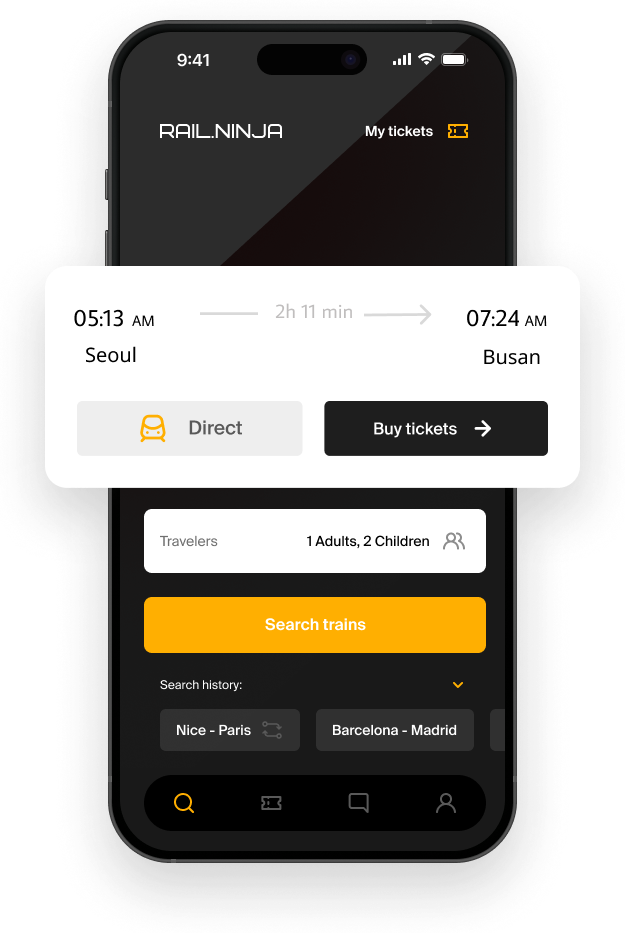
The most convenient way to reach Busan from Seoul is by KTX high speed train. The Gyeongbu KTX route covers 408.5 km — most services complete the journey in about 2 hours 15 minutes, with the fastest travel time of 2 hours 8 minutes. There are around 56 trains per day. You can search and book KTX tickets online at Rail.Ninja. SRT trains also connect Seoul (Suseo Station) with Busan at slightly cheaper fares.
The most convenient way is by KTX high speed train. The travel distance is 94 km, there are 18 trains per route, and the shortest travel time is around 38 minutes.
You can find all KTX routes and departures at Rail.Ninja online booking platform. KTX tickets can be booked online up to 2 years in advance — booking ahead is strongly recommended during peak travel seasons, weekends, and public holidays.
KTX trains stop at different stations depending on the service. KTX stops on the Gyeongbu line include: Haengsin – Seoul – Yeongdeungpo – Gwangmyeong – Suwon – Cheonan Asan – Osong – Daejeon – Gimcheon (Gumi) – Dongdaegu – Miryang – Gupo – Busan – Pohang – Singyeongju – Ulsan.
Yes. South Korea operates KTX trains (Korea Train Express) — a high speed train service reaching maximum speeds of 305 km/h, comparable to Japan's Shinkansen or China's CRH high speed rail network.
KTX trains operate at speeds up to 305 km/h and can reach a maximum speed of 330 km/h. Read more about KTX trains speed, classes and amenities here.
There are two main types of KTX trains: KTX-I and KTX-II, renamed KTX-Sancheon. KTX-Sancheon trains entered service on March 2, 2010. KTX-Sancheon offers Superior Class and Standard Class seating, with wider first class seats than KTX-I. Seats always face the direction of travel, and passengers enjoy free wi-fi and digital multimedia broadcasts onboard.
The KTX Eum is the newest generation of Korean high speed trains, entering service in 2021. It features a modern interior, enhanced comfort, wider legroom, and extra legroom in first class. KTX Eum trains currently operate on the Gyeongbu line and are expanding to additional routes.
The South Korean rail network operates high speed, semi-high speed, and conventional lines. ITX-Saemaul is a fast conventional intercity train — conventional trains travel at 120–150 km/h. Mugunghwa trains are the most common regular trains in Korea, stopping at almost every station and offering affordable long distance travel. SRT trains (Super Rapid Train) operate from Suseo Station at up to 305 km/h, with fares generally cheaper than KTX.
KTX tickets can be purchased at vending machines or station counters, or booked online via Rail Ninja or the Korail website. Book KTX tickets online up to 2 years in advance to secure the best ticket prices and your preferred seat. Discounts for KTX tickets can reach up to 30% for groups, with additional discounts for children and seniors. The Korail Pass allows unlimited long distance travel on KTX for a set number of days.
Jeju Island cannot be reached by train. Travelers must take a flight or use ferry services — ferries depart from ports like Mokpo, accessible by KTX from Seoul Station.
KTX trains offer onboard food services with snacks and drinks available from a vending machine (seat service only — no dining car). Passengers can also bring their own food. Free wi-fi is available on many KTX routes, allowing passengers to stay connected on their mobile phone or laptop. Clean restrooms and power outlets are available in each car. Mobile phone use is allowed but should be considerate of other passengers.
Jeju Island cannot be reached by train. Travelers must take a flight or use ferry services — ferries depart from ports like Mokpo, accessible by KTX from Seoul Station.